
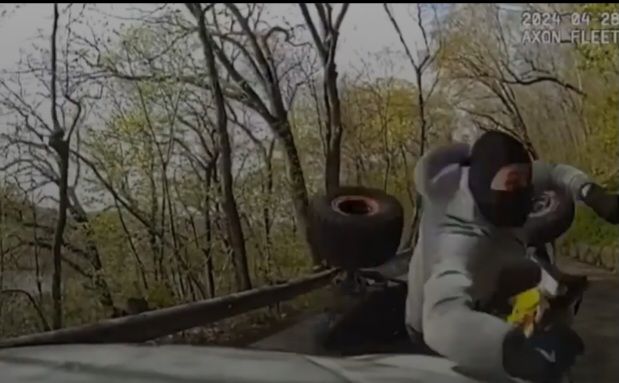
Recent footage from a dashcam video provided by the New Haven Police Department may spark a debate on the utilization of force by law enforcement officers. The video captures a moment where an officer intervenes to stop a reckless ATV rider speeding down a crowded walkway, may raise some questions about where the line is drawn between excessive force and necessary action.
In the footage, an ATV is seen barreling down a walkway populated with pedestrians, cyclists, and children. The officer, in an attempt to prevent harm to the public, maneuvers their vehicle to intercept the ATV. The result is a collision that stops the ATV, but also raises concerns about the level of force used by the officer.
The incident brings us to a broader discussion on the role of law enforcement in maintaining public safety while respecting individual rights. On one hand, it could be said that action was needed to prevent a potentially dangerous situation from escalating. The ATV posed a clear threat to the safety of pedestrians, especially given its high speed and the presence of children in the area.
However, the manner in which the officer chose to intervene may have been then only way. Critics may argue that using a police vehicle to stop the ATV may have been excessive, especially considering the risk of injury to the ATV rider. Some may even suggest alternative methods could have been employed, such as deploying roadblocks further ahead.
The question then arises: who ultimately determines what constitutes excessive force versus necessary action in such situations? Law enforcement agencies often have guidelines and training protocols in place to address these issues. However, the interpretation of these guidelines can vary, leading to discrepancies in how force is applied.
Moreover, societal perceptions and attitudes towards law enforcement play a significant role in shaping these discussions. Instances of excessive force captured on video can erode trust between communities and law enforcement agencies. Conversely, instances where officers are perceived as not taking decisive action in critical moments can also lead to criticism.
Ultimately, finding the balance between maintaining public safety and respecting individual rights is a complex challenge. It requires ongoing dialogue between law enforcement agencies, policymakers, community members, and civil rights advocates. Training programs that emphasize de-escalation tactics, cultural sensitivity, and ethical decision-making can help officers navigate these situations more effectively.
As communities continue to grapple with issues of excessive force and necessary action, it is essential to foster an environment where dialogue and collaboration can lead to meaningful reforms. Only then can we work towards a future where public safety is upheld without compromising individual rights and dignity.
 The Waterbury Times- Waterbury,CT Local News
Leave a comment