
By D.M.Livingston|Published Nov 25, 2025
Waterbury, CT For years, cities across America have rushed to embrace Amazon, Walmart, and the other warehouse giants that promise jobs, investment, and economic revival. On paper, these deals look like an answer — especially for post-industrial communities hungry for growth. But as more massive distribution centers rise across Connecticut, a harder question emerges: does the end justify the means?
Waterbury is living that question right now.
The Cost You Can See — and the Cost You Feel
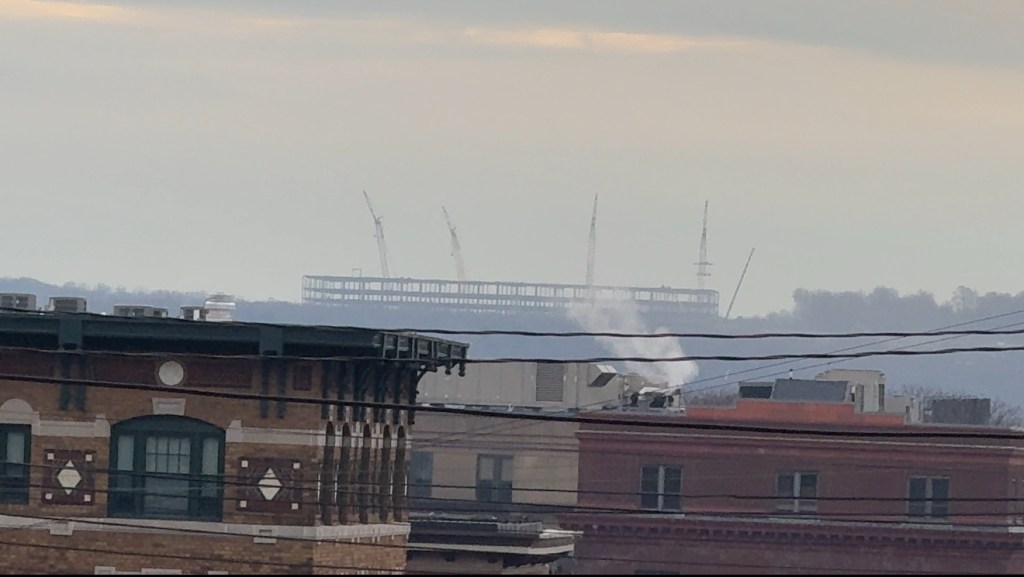
For residents living near large warehouse construction sites ( and across town )the impacts are not theoretical. Blasting shakes homes. Wildlife disappears as hillsides are cleared. Natural buffers that once protected neighborhoods are stripped away.
And then comes the traffic — trucks, vans, and employee vehicles pouring into streets not built to handle that kind of volume. Even before these facilities open, nearby families are already feeling the strain.
This is the side of development that rarely makes the ribbon-cutting speeches or other news outlets.
Opinion & Editorials | Waterbury Times – Local Perspectives and Analysis
The Promise: Jobs and Economic Boost
Developers, and sometimes public officials, highlight the upside. A warehouse means:
- Jobs for local adults and young workers
- Increased tax revenue
- Secondary spending at nearby businesses
- Momentum for additional investment
These benefits are real — but they don’t exist in a vacuum. The real question is whether they outweigh what the community gives up to get them.
The Trade-Off Cities Ignore Too Often
Across the country, the same pattern repeats itself:
A huge warehouse comes in with big expectations. But the majority of the long-term jobs tend to be low-wage, high-turnover, and ran by machines. Meanwhile, the construction jobs — the ones often used to sell the project — are temporary and contracted out to the highest bidder.
Small businesses, the backbone of local economies, rarely see the boom they’re promised. In some cases, they face the opposite:
- More competition from corporate supply chains
- Difficulty competing with warehouse wages
- Shifts in foot traffic away from local commerce
When cities roll the dice on one giant company, they often do so at the expense of the entrepreneurial ecosystem that keeps real money circulating locally.
Environmental Reality: Once It’s Gone, It’s Gone
You can rebuild a road.
You can renegotiate a tax deal.
But you cannot rebuild a blasted hillside or resurrect wildlife once a forest is flattened.
These costs are permanent, and Waterbury residents have a right to question whether the sacrifice of natural land, peace, and safety is worth the payout.
Does the Investment Justify the Impact?
This is the real question Waterbury must ask itself — not whether Amazon or any other warehouse giant is “good” or “bad,” but whether the full equation makes sense for the people who live here.
Cities often treat these deals like a chance opportunity, but in reality, municipalities have power. They can demand:
- Stronger community benefit agreements
- Road upgrades funded by developers
- Environmental protections and monitoring
- Local hiring commitments
- Investments in youth and small businesses
If a corporation want to make a bag from Waterbury land, Waterbury should receive a bag — not speculation — returns.
A Future Built on Balance
Warehouse development is not inherently harmful. What becomes harmful is blind enthusiasm — the mindset that any big company is automatically a blessing.
Waterbury stands at a crossroads. The city can choose to simply welcome large corporations and hope for the best, or it can negotiate from a position of strength and insist on development that respects the residents, the environment, and the long-term health of the city.
Economic growth means nothing if the people living next to that growth are paying the price.
This is the conversation Waterbury must have — not years from now, but right now, while there is still time to shape the future rather than react to it.
 The Waterbury Times- Waterbury,CT Local News
Leave a comment