
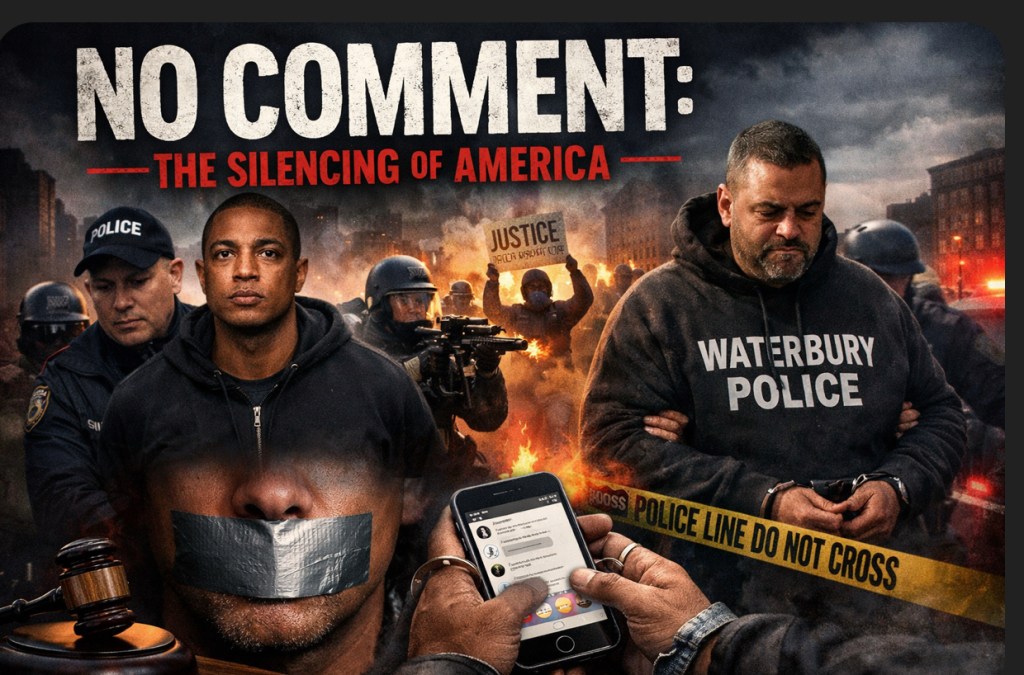
A Waterbury Times SUNDAY Special Report
By D.M.Livingston|The Waterbury Times|Published Feb 8, 2026
Listen 🎧 here
Waterbury-Something’s shifting in this country—and folks in the inner cities feel it first.
Lately, it feels like you can catch a case faster for what you say than what some people actually do. From national headlines to right here in Waterbury, words are starting to move like weapons in the eyes of the system—and that should make everybody uncomfortable.
We’ve seen it nationally: high-profile figures caught up in investigations, protesters killed during moments of unrest, and citizens facing charges after heated exchanges or online posts. Every case is different, but the pattern feels familiar—speech is no longer just speech. It’s evidence. It’s motive. Sometimes, it’s the whole case.
Then it hit home.
A Waterbury Police Sergeant is now on administrative leave, charged with interfering with an investigation. According to official information, that investigation started over Facebook comments. No verdict. No conviction. Just facts as they stand. But let’s not pretend that detail doesn’t matter.
Waterbury Police Sergeant Arrested, Placed on Administrative Leave
Facebook comments.
That’s the spark.
At the same time, local resident Vic Cuevas was arrested over language—words that were offensive, reckless, or heated depending on who you ask. And that’s where the question really starts: Since when did saying the wrong thing become grounds for handcuffs?
Waterbury Man Arrested in Alleged “Hate” Incident Following Grand Street Disturbance
Let’s be clear before anyone twists this:
Threats are not protected. Harassment isn’t protected. Calling for violence isn’t protected. That’s the law, and it should be.
But what people are worried about isn’t the obvious stuff. It’s the gray area. The moments where anger, sarcasm, trauma, or frustration spill out online—and suddenly that post is framed like a criminal act. Context disappears. Intent gets assumed. And the internet never forgets.
In inner cities, we already know how this goes.
We’ve lived through eras where how you talk, how you dress, how loud you are, or how angry you sound gets interpreted as danger. Now that same logic is moving online. The corner has gone digital. And surveillance didn’t stop at the stop sign—it followed us onto our timelines.
Police departments are under pressure to stop something before it happens. Social media turns arguments into flashpoints in seconds. Nobody wants violence. Nobody wants chaos. But when prevention turns into overreach, the people always feel it first—especially Black and brown communities that already know what it’s like to be misunderstood by default.
The real damage isn’t always the arrest. It’s the silence that follows.
People stop posting. Stop joking. Stop venting. Stop speaking truth to power because they don’t know how it’ll be read, screenshot, or spun. When silence feels safer than honesty, freedom of speech doesn’t disappear—it freezes.
History tells us this doesn’t happen overnight. Rights don’t vanish in one big dramatic moment. They shrink slowly. Case by case. Exception by exception. Always “for safety.” Always “just this time.”
So no—this isn’t about defending bad language.
It’s not anti-police.
It’s not pro-chaos.
It’s about asking where the line is now—and who gets to move it.
Because when words start carrying felony weight, when comments spark investigations, and when “say less” becomes a survival strategy, we’re not just changing the rules.
We’re changing the culture.
And the most dangerous thing in a democracy isn’t somebody talking reckless.
It’s everybody deciding to say nothing at all.
No comment.
 The Waterbury Times- Waterbury,CT Local News
Leave a comment