
The Waterbury Times|Published Jan 6, 2026
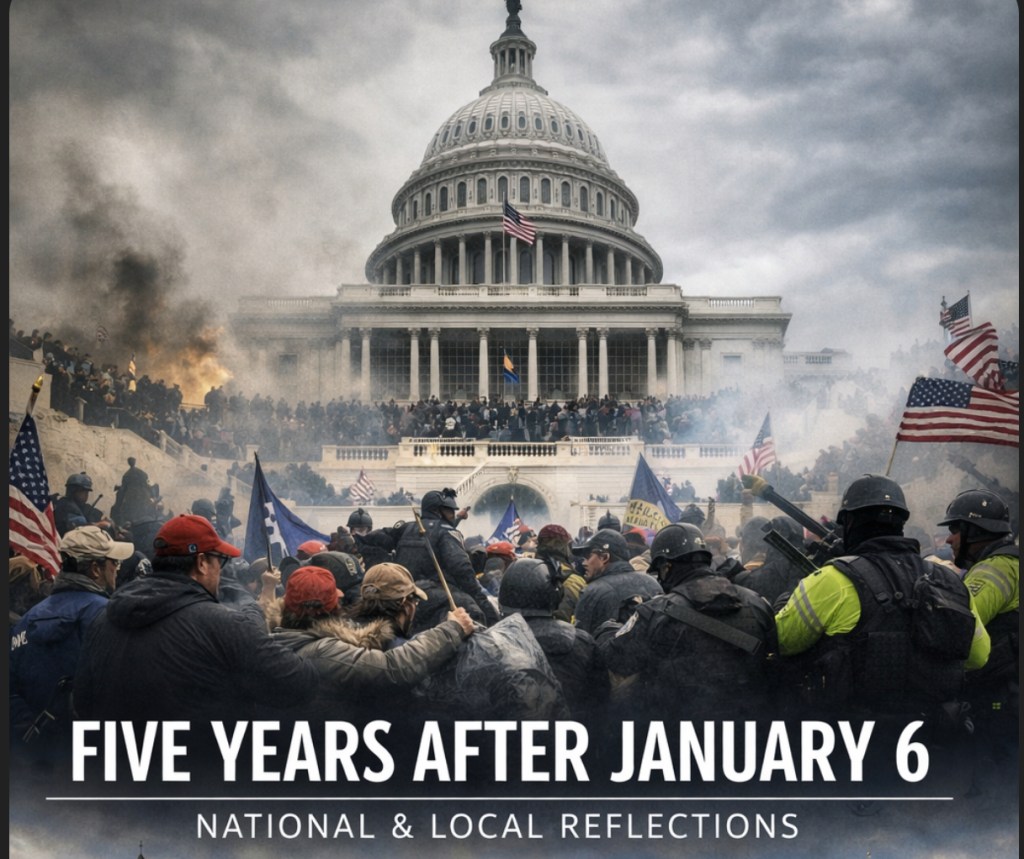
WATERBURY, CT — Today marks five years since the January 6, 2021 attack on the U.S. Capitol, an event that disrupted the peaceful transfer of power and reshaped American political life. Half a decade later, the question remains: what has actually changed? The answer depends on where one looks — nationally, statewide, and here at the local level in Waterbury.
Nationally: Accountability Met With Reversal
In the years immediately following January 6, the federal government launched the largest criminal investigation in U.S. history. Thousands of individuals were charged, and hundreds were convicted for crimes ranging from unlawful entry to assaulting law enforcement officers and obstructing an official proceeding. For a time, the prosecutions signaled an effort to reinforce democratic norms and the rule of law.
Two Stabbed in Grove Street Apartment Building Waterbury
That trajectory shifted sharply in 2025. Broad presidential pardons and sentence commutations erased or reduced consequences for many convicted in connection with the attack. Records were removed, cases were closed, and legal accountability was significantly narrowed. While some prosecutions continue, particularly in cases involving explosives or organized planning, the overall national message has become less clear.
Five years later, January 6 exists in a contested space — recognized by some as an attack on democracy and minimized by others as a protest that went too far. There is still no permanent, universally recognized federal memorial for the law enforcement officers who defended the Capitol, reflecting the unresolved nature of how the country chooses to remember the event.
Institutional Changes Without Cultural Resolution
Security at the U.S. Capitol has been strengthened. Emergency response protocols have been revised. Intelligence sharing has improved. On paper, institutions are better prepared for a similar threat.
Culturally and politically, however, the divisions exposed in 2021 have not healed. Distrust in elections remains elevated. Political violence is discussed more openly than it was before January 6. Faith in democratic institutions continues to erode among large segments of the population. The systems may be stronger, but the consensus around them is weaker.
Waterbury Police Investigating Serious UTV Crash on Bank Street
Connecticut: Reflection Without Radical Shift
In Connecticut, the January 6 anniversary has consistently been marked by reflection rather than disruption. The state did not experience large-scale violence connected to the attack, but residents were not insulated from its consequences. Connecticut citizens were among those charged federally, and state leaders have repeatedly emphasized the importance of protecting democratic norms and election integrity.
Five years later, Connecticut’s civic infrastructure looks much the same. Elections remain orderly. Public trust is higher here than in many parts of the country, though not immune to national polarization. Civic education, media literacy, and youth engagement have become more prominent topics in schools and community organizations, driven in part by lessons drawn from January 6.
Waterbury: Democracy at the Ground Level
In Waterbury, January 6 did not arrive in the form of violence, but its impact has been felt through heightened political awareness, skepticism, and engagement. Local politics have grown more visible. Board meetings draw more attention. Residents scrutinize leadership, transparency, and process more closely than they did five years ago.
Local media and civic institutions have taken on a larger role in translating national issues into local understanding. The events of January 6 reinforced a truth often overlooked: democracy is not only defended in Washington, but maintained in city halls, school boards, and neighborhood conversations.
Waterbury’s experience over the last five years reflects a broader national reality — that democratic stability depends less on dramatic moments and more on daily participation, informed citizens, and accountable local leadership.
Five Years Later: An Unfinished Reckoning
January 6 is no longer breaking news, but it is not settled history. The legal chapter has been partially rewritten. The political lessons remain disputed. The cultural consequences continue to unfold.
What has changed most since 2021 is not the presence of division, but the normalization of it. What has not changed is the responsibility placed on citizens — including those in Waterbury — to engage, question, vote, and remain vigilant.
Five years later, the story of January 6 is no longer just about what happened at the Capitol. It is about what Americans choose to do with the memory of it.
Stay linked for more
 The Waterbury Times- Waterbury,CT Local News
Leave a comment