
The Waterbury Times|Sept 24, 2026
A Paid Political Op-Ed by Faithalee Goclowski for the 75th
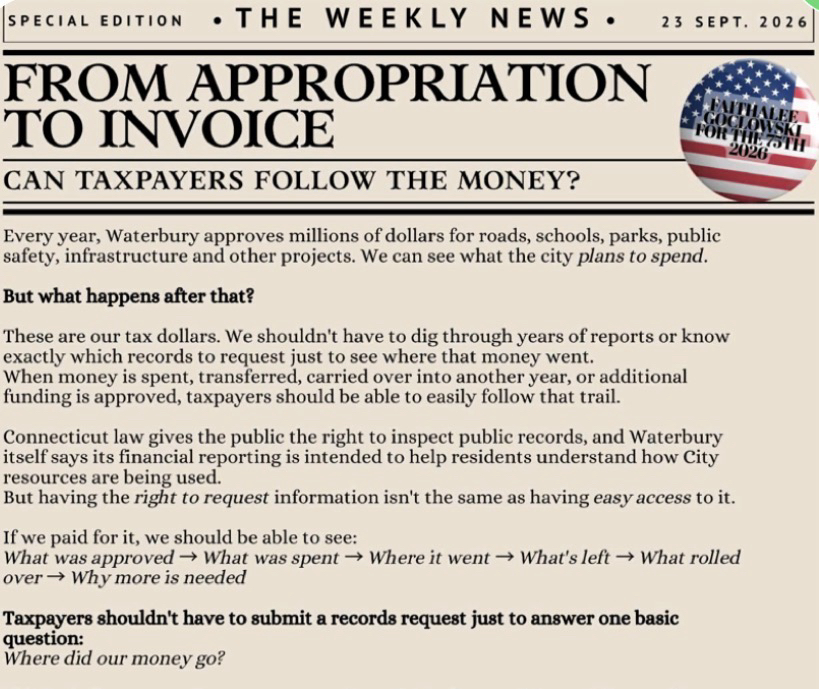
Waterbury- Every year, the City of Waterbury approves millions of dollars for roads, schools, parks, public safety, infrastructure and other municipal priorities.
The public can see the budgets.
But can taxpayers easily follow the money after an appropriation is approved?
That is the question at the center of this campaign’s proposal for greater financial transparency.
Waterbury already makes substantial financial information available to the public. The city’s Office of Budget Control maintains budgets, financial reports and financial plans, and its responsibilities include processing budget transfers and additional appropriations.
Connecticut law also gives residents broad rights to inspect and obtain public records maintained by government agencies.
But access to records and ease of understanding those records are not necessarily the same thing.
A taxpayer should not need to be a municipal-finance expert to understand what happened to money appropriated for a public project.
The basic trail should be understandable:
What was approved → What was spent → Where it went → What’s left → What rolled over → Why additional money was needed.
If a project costs more than originally anticipated, taxpayers should be able to see the reason.
If funds are transferred, the public should be able to see where they went.
If a project extends into another fiscal year, residents should be able to see how much has been spent and what remains.
And if additional funding is requested, taxpayers should be able to see the history of the money that was already appropriated.
This argument does not require an assumption that anyone has misused public money.
It is an argument about visibility.
Waterbury’s financial documents contain important information. The city’s annual financial reporting, for example, distinguishes between original budgeted amounts, final budgeted amounts and actual expenditures.
The question is whether that information can be brought together in a way that allows an ordinary resident to follow a particular appropriation from beginning to end.
That could mean creating a searchable public spending database.
It could mean linking appropriations to contracts, purchase orders and expenditures.
It could mean showing remaining balances and transfers in one place.
It could mean identifying projects that carry money from one fiscal year into another.
Whatever form it takes, the goal is straightforward:
Make the public’s money easier for the public to follow.
Freedom of Information laws are essential. Connecticut’s FOI Act gives residents the right to inspect public records and obtain copies, subject to statutory exemptions.
But transparency does not have to begin with a records request.
It can begin with the way government publishes information in the first place.
Taxpayers fund city government.
They should be able to see how that money moves through city government.
If taxpayers fund it, taxpayers should be able to follow it.
This paid political op-ed was submitted by Faithalee Goclowski’s campaign. The views expressed are those of the campaign and do not necessarily reflect the views of The Waterbury Times.
Faithalee Goclowski Marks 9/11 Anniversary at Waterbury City Hall Amid Family Tragedy
Waterbury Community Comes Together for Movie Night at Hamilton Park Hosted by Faithalee Goclowski
“This Week, I’m Just a Mom”: Faithalee Goclowski Shares Heartfelt Message After Loss of Son
United Neighborhoods, Stronger Futures: A Message to the 75th District- Waterbury
Leave a Reply