

From Lexington to Baghdad, the Cost of Freedom Never Became Abstract
The Waterbury Times|2026 Memorial Day|Published May 25, 2026
Waterbury- For the past seven days, The Waterbury Times has looked back at the wars that shaped the United States — from the American Revolution to the modern War on Terror. We revisited battlefields, generations, political divisions, sacrifice, and the men and women who carried the burden of history on their backs.
Now, on Memorial Day 2026, that reflection carries even more weight.
This year marks the beginning of America’s 250th anniversary observance — a quarter millennium since a group of colonies made the decision to become a nation. Two hundred and fifty years later, Memorial Day remains one of the few moments where the country pauses long enough to confront what that decision has cost.
Not in slogans.
Not in campaign speeches.
Not in social media posts.
But in gravesites. In folded flags. In old photographs. In names etched into stone.
Memorial Day was never designed to celebrate war itself. It exists because war leaves people behind.
And every American generation has learned that lesson differently.
The Revolution created the country. The Civil War nearly destroyed it. World War I introduced industrial-scale death. World War II reshaped the globe and defined an American century. Korea became the “Forgotten War,” even for those who fought it. Vietnam fractured trust at home. The Gulf War reintroduced overwhelming American military power to a televised generation. The post-9/11 wars in Iraq and Afghanistan became the longest sustained conflict era in modern American history.
The uniforms changed. The weapons changed. The politics changed.
The loss never did.
That is what ties 1776 to 2026 together.
Across 250 years, Memorial Day remains less about victory and more about memory — about the understanding that freedom, stability, and even national identity were purchased by people who often never lived long enough to see the results.
In 2026, that message lands differently than it once did.
America is louder now. Faster. More divided. More distracted. Historical attention spans have shortened. National moments disappear within hours. Entire wars are debated through algorithms and headlines before the human cost is fully understood.
But cemeteries remain quiet.
That silence is what Memorial Day asks Americans to sit with.
Not blind patriotism. Not political theater. Just remembrance.
Because behind every war statistic was somebody’s son, daughter, brother, sister, parent, classmate, or friend.
And for many families, Memorial Day is not symbolic. It is personal.
The Waterbury Connection
Waterbury’s story has always been tied to America’s story.
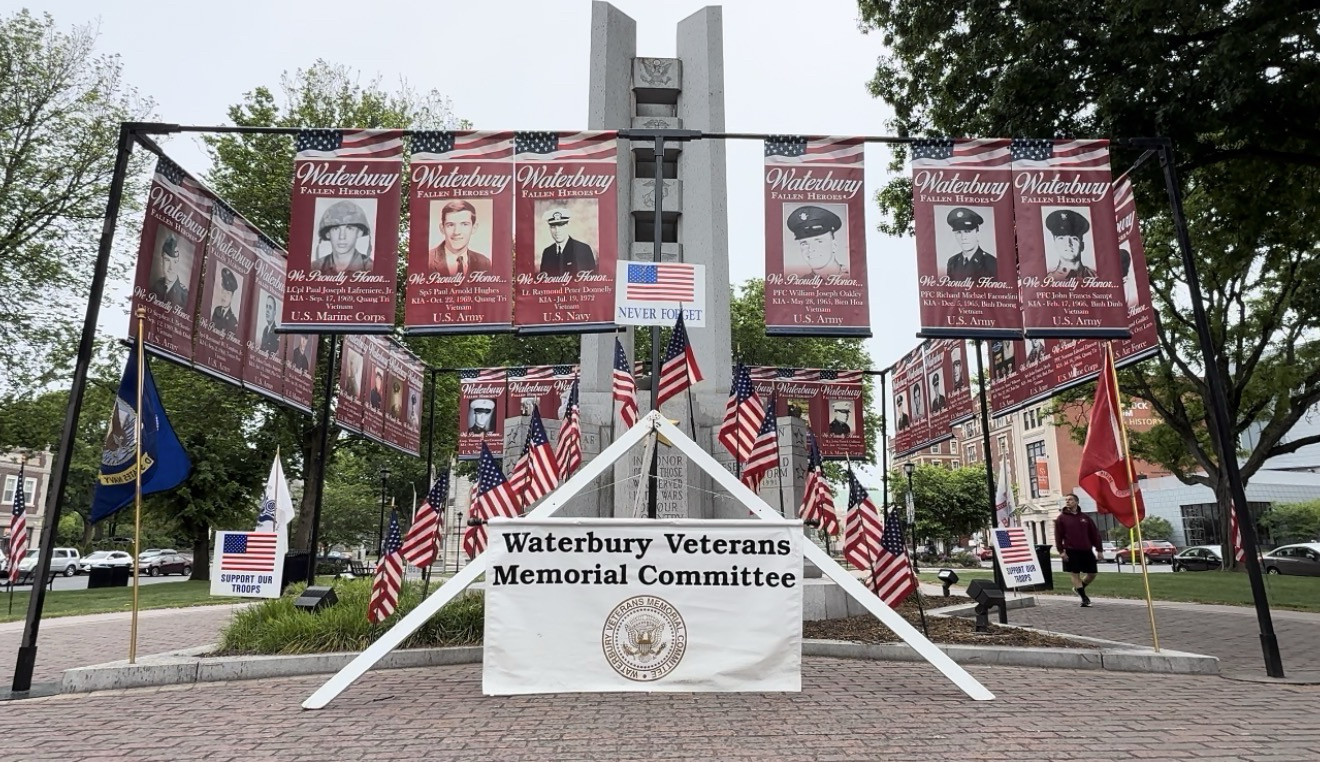
For generations, city residents answered military calls during moments of national crisis. Waterbury men fought in the Revolution, marched during the Civil War, stormed beaches in World War II, served in Korea and Vietnam, deployed to the Persian Gulf, and later fought in Iraq and Afghanistan during the War on Terror.
Entire neighborhoods in Waterbury carry that legacy quietly.
Some families have military service spanning multiple generations. Others still hold onto old letters, medals, uniforms, newspaper clippings, or folded flags handed to them after funerals. Veterans organizations across the city continue to preserve memories that become harder to hold onto with each passing decade.
Memorial Day in Waterbury has never only been about national history. It has always been local too.
The city’s memorials, parks, ceremonies, and parades represent more than tradition — they are reminders that global events reached ordinary streets here at home.
Young men left Waterbury and never returned. Others came home carrying wounds people could not always see.
And while wars are often remembered through presidents, generals, and politics, communities like Waterbury remember them differently: through absence.
An empty chair at dinner.
A name on a monument.
A photograph that stopped aging decades ago.
As America approaches its 250th birthday, Memorial Day remains one of the strongest reminders that history is not something distant. It lives in cities like Waterbury every day.
That is why remembrance still matters.
Not because America’s past is perfect.
Not because every war was universally supported.
But because sacrifice deserves memory, even when history remains complicated.
Two hundred and fifty years after the founding of the United States, Memorial Day continues to ask the same question it always has:
Will we remember the people who carried the weight of the country before us?
Today, across Waterbury and across America, that answer should still be yes.
This Memorial Day series is part of a broader Parker Jane Public Benefit Corporation initiative focused on preserving history through local storytelling. By connecting national events to the experiences of everyday communities like Waterbury, the project aims to ensure that sacrifice, service, and generational memory are not lost to time or reduced to headlines. Through journalism, community voices, and historical reflection, Parker Jane and The Waterbury Times remain committed to documenting the people, neighborhoods, and stories that continue to shape the American experience 250 years later.
Leave a Reply