
The Waterbury Times|Investigates|Sept 24, 2026
Inside the DeBarros-Shea Republican Convention Fight

There were 215 ballots.
There were 208 eligible delegates.
Then the convention stopped.
That discrepancy, buried inside a May Republican congressional convention in Connecticut, is at the center of a question The Waterbury Times believes deserves a closer look:
What actually happened to the votes?
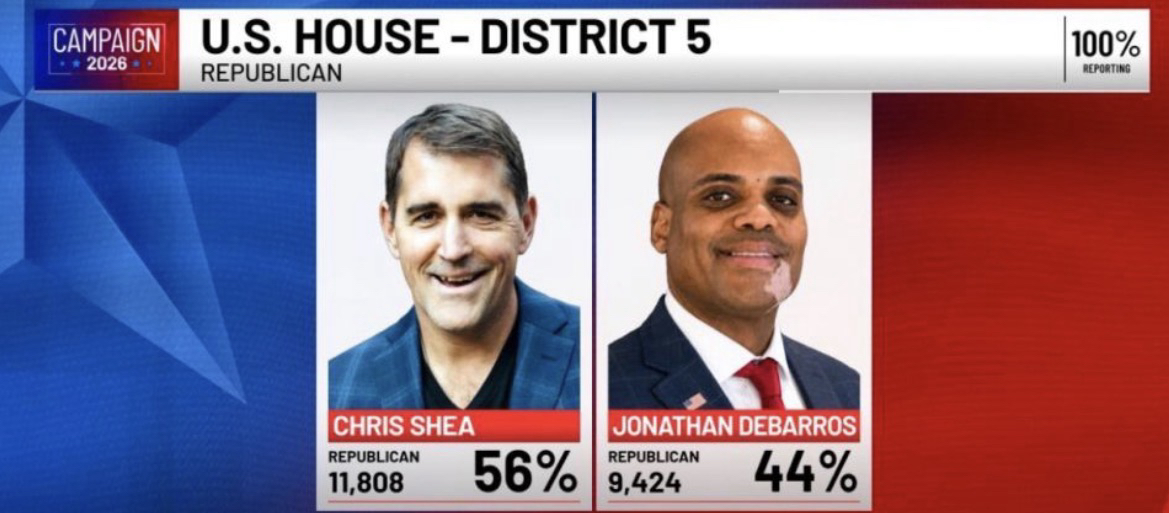
The question is not who ultimately won the Republican nomination for Connecticut’s 5th Congressional District. Chris Shea defeated Jonathan DeBarros in the August 11 primary.
The question is what happened before voters ever went to the polls — inside the Republican convention where the two candidates first faced one another, where delegates cast ballots, where the validity of those ballots was questioned, and where delegates were subsequently given an opportunity to reconsider their votes.
The Waterbury Times is examining the convention record, the rules governing the vote and the documentary trail surrounding the episode.
At this point, the available public record establishes a discrepancy.
It does not, by itself, establish wrongdoing.
That distinction matters.
215 ballots. 208 eligible delegates.
On May 15, Republicans gathered at the Connecticut Republican Party convention to select candidates for the 5th Congressional District.
More than 200 delegates were involved in the congressional convention.
According to contemporaneous reporting by the Connecticut Post, 215 first-ballot votes were cast, but only 208 delegates were determined to be eligible.
The reason given was a registration requirement and a line of people waiting to pass through security at the convention site.
The discrepancy was significant enough that state Sen. Eric Berthel, who was serving as moderator of the 5th District convention, called a recess at approximately 4:15 p.m.
The convention eventually resumed.
But the arithmetic remains part of the public record.
And it raises an obvious question:
If 208 delegates were eligible, why were 215 ballots cast?
That question has another layer.
The same contemporaneous report described the first-ballot result as 166 votes for Shea and 48 for DeBarros.
That totals 214.
So the publicly reported numbers leave a three-part accounting question:
215 ballots were reportedly cast.
208 delegates were reportedly eligible.
The published Shea-DeBarros tally totals 214.
Was one ballot blank?
Was one ballot invalidated?
Was one ballot attributed to another candidate?
Was the 215 figure later corrected?
Was the eligibility determination different from the number of people physically voting?
Or is there another explanation contained in the official convention record?
Those are not conclusions.
They are questions.
And they are questions that can be answered with records.
The vote did not end with the first count
The convention fight did not simply consist of one ballot and one result.
DeBarros later said that he initially received approximately 30% of the convention vote.
After delegates were given an opportunity to change their votes, his support fell to approximately 22%.
The Connecticut Mirror reported in July that DeBarros said delegates were permitted to reconsider their votes under the rules governing the convention. He remained above the 15% threshold required to pursue a primary.
That distinction is important.
A delegate changing his or her vote is not, by itself, evidence of an improper election.
Political conventions are political gatherings. Delegates can hear arguments, talk with candidates, reconsider their choices and vote accordingly.
Connecticut’s Republican Party bylaws provide that a candidate seeking to force a primary for a district office may do so after receiving at least 15% of the votes of convention delegates present and voting on any roll call taken on endorsement or proposed endorsement. The bylaws were approved by the Republican State Central Committee in March 2026.
Connecticut’s Secretary of the State likewise explains that a candidate who receives at least 15% of the convention vote can qualify for ballot access, provided the required certification is filed.
So DeBarros did not need to win the convention.
He needed to clear the threshold.
He did.
The August primary therefore became possible.
But how many people were actually voting?
This is where the investigation becomes more than a campaign dispute.
The Connecticut Republican Party’s bylaws say that no person may have more than one vote at a convention, whether serving as a delegate or as an alternate for another delegate, and that action is valid when carried out by a majority of delegates present and voting.
That makes the delegate list important.
So does the ballot count.
The public should be able to determine:
- How many delegates were certified for the 5th Congressional District convention?
- How many actually checked in?
- How many were determined eligible to vote?
- How many ballots were distributed?
- How many ballots were returned?
- How many ballots were counted?
- How many were rejected or voided?
- Were blank ballots included in the announced totals?
- Was there more than one roll call?
- Were delegates identified by town?
- Were votes recorded by individual delegate, by town delegation or only as an aggregate?
- Who physically counted the ballots?
- Who certified the results?
- Was a written tally preserved?
These are basic election-administration questions.
They are also questions that should have answers.
What happened during the recess?
The convention’s recess is another piece of the story.
According to the Connecticut Post, the discrepancy over the 215 ballots and 208 eligible delegates prompted the moderator to stop the proceedings while the issue was addressed.
The Waterbury Times wants to know what happened during that period.
Was a formal ruling made?
Was the convention parliamentarian consulted?
Did representatives of the campaigns participate?
Were ballots physically separated?
Were additional eligibility checks conducted?
Were any ballots removed?
Were delegates added or removed from the eligible voting pool?
Was a written ruling issued?
Was the ruling entered into the convention minutes?
And, perhaps most importantly:
What numbers did the convention itself ultimately certify?
Those records would allow the public to move beyond competing recollections.
The Waterbury connection
The dispute also deserves examination at the local level.
DeBarros and Shea competed for support throughout the 5th Congressional District, including in Waterbury and Woodbury.
The August primary provides a separate set of numbers with which to compare the convention result.
But those two elections should not be confused.
A convention vote is made by a limited group of party delegates.
A primary is decided by eligible Republican voters.
They are different electorates, under different rules, at different points in the campaign.
A difference between the two does not establish that anything improper happened at the convention.
But it does provide another reason to preserve and examine the underlying convention records rather than relying solely on campaign accounts.
The records The Waterbury Times is seeking
The Waterbury Times is seeking the documentary record necessary to reconstruct the convention.
Among the records we believe should be examined:
1. The certified delegate list
The complete list of delegates certified for the 5th Congressional District convention, including alternates where applicable.
2. Check-in records
Documentation showing which delegates actually arrived and were admitted.
3. Eligibility determination
Any record showing the final number of delegates deemed eligible to vote.
4. Ballot accounting
The number of ballots distributed, returned, counted, rejected, voided or otherwise excluded.
5. Convention minutes
The official minutes of the 5th Congressional District convention.
6. Roll-call results
Every recorded vote concerning endorsement, including any first ballot, reconsideration or subsequent ballot.
7. Town-by-town results
If votes were recorded by delegation, the complete town-level tally.
8. Rules and parliamentary rulings
Any written interpretation or ruling concerning delegate eligibility, registration, voting procedures or the ability of delegates to change their votes.
9. Certification filed with the Secretary of the State
Connecticut requires convention endorsements and 15% candidate certifications to be filed with the Secretary of the State within the statutory deadline.
Those filings could help establish exactly what the party certified after the convention.
The question isn’t whether someone changed their mind
There is an important distinction between changing a vote and changing the vote count.
Those are not the same thing.
A delegate who initially supports one candidate and later votes for another has exercised the political choice available to that delegate.
The investigative question is different:
Was every ballot counted according to the same rules?
And:
Can the final numbers be independently reconstructed from the surviving records?
If the answer is yes, the records should show it.
If the answer is no, that is also information the public deserves to know.
What we know — and what we don’t
At this stage, The Waterbury Times can establish several facts from publicly available material.
A Republican convention was held in May to select a candidate for the 5th Congressional District.
Chris Shea finished ahead of Jonathan DeBarros.
Contemporaneous reporting said 215 first-ballot votes were cast while 208 delegates were considered eligible.
The discrepancy resulted in a recess.
The published Shea-DeBarros first-ballot numbers reported by the Connecticut Post totaled 214.
DeBarros later said his support fell from approximately 30% to approximately 22% after delegates were permitted to reconsider their votes.
He remained above the 15% threshold necessary to pursue a primary.
And Connecticut law and Republican Party rules recognize the 15% convention threshold for a candidate seeking to continue to a primary.
What the public record available to us does not yet establish is why the numbers do not line up.
That is precisely why the records matter.
The Waterbury Times will follow the paper trail
Political campaigns produce plenty of allegations.
Records produce something different.
They produce something that can be checked.
The Waterbury Times is not beginning this investigation with the conclusion that votes were improperly counted.
We are beginning with a simpler question:
What happened?
If the convention’s official records resolve the discrepancy, we will report that.
If the records reveal an administrative error, we will report that.
If the records contradict the public account of what happened, we will report that too.
And if the evidence shows that the voting process followed the rules despite the confusing numbers reported at the time, that deserves to be reported just as plainly.
Because the issue is larger than DeBarros.
It is larger than Shea.
It is larger than one Republican convention.
When political parties select candidates through conventions, delegates are exercising a public-facing political function that determines who gets access to the next stage of the electoral process.
The public should be able to understand how that decision was made.
The ballots may have been counted months ago.
The questions remain.
The Waterbury Times Investigates.
Leave a Reply